
Amber Bannister
Real Estate ● 26 Jan 2026
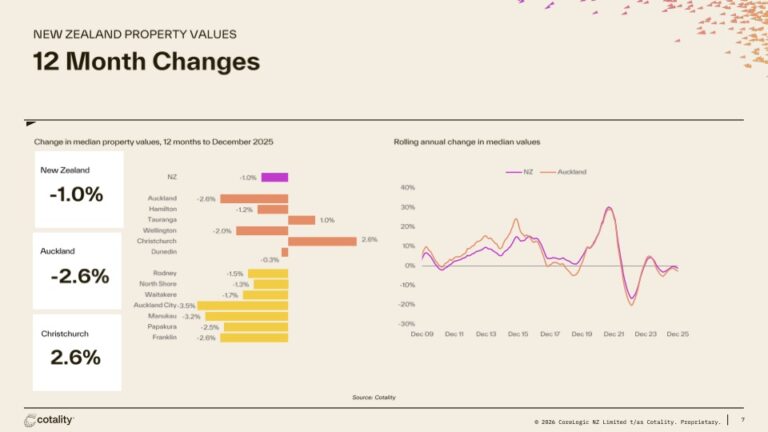
After several years of sharp movements, New Zealand’s property market is showing clearer signs of stabilisation. The latest 12-month data to December 2025 points to a market that has largely absorbed its correction, with outcomes increasingly differing by region.
Rather than broad-based declines, the picture is now one of modest national softness alongside pockets of resilience.
National View: Slight Decline Over the Year
Across New Zealand, median property values fell by 1.0% over the 12 months to December 2025. In historical terms, this is a relatively small annual movement and suggests the steep phase of the downturn is behind us.
This level of change reflects a market that is no longer falling rapidly, but instead consolidating as affordability improves and buyer confidence slowly rebuilds.
Auckland: Still Adjusting
Auckland continues to lag the national average, with values down 2.6% over the past year. Several Auckland sub-markets recorded larger declines, particularly in areas that experienced the strongest price growth during the boom years.
Affordability pressures, elevated supply, and more cautious buyer behaviour have all contributed to Auckland’s slower recovery.
Christchurch: A Clear Standout
Christchurch again stands apart from the other main centres. Over the past 12 months, property values there increased by 2.6%, making it one of the strongest-performing major markets in the country.
Relatively affordable prices, steady population growth, and a more balanced supply-demand dynamic have helped Christchurch outperform.
Other Centres: Mixed but Improving
Elsewhere, the picture is mixed:
This variation reinforces that national averages now hide very different local outcomes.
From Correction to Consolidation
The rolling annual change data shows the extreme volatility of 2022 and 2023 has passed. While growth has not yet returned in a meaningful way at a national level, the market has shifted into a more stable, measured phase.
Lower mortgage rates, improved affordability, and easing supply pressures are gradually providing support — though confidence remains cautious.
The big takeaway
Over the past year, New Zealand’s property market has moved from sharp correction to relative stability. National values are only slightly lower, Auckland is still adjusting, and Christchurch continues to lead.
As we head further into 2026, recovery is likely to be slow and uneven, driven by local conditions rather than a nationwide surge.
Source: Cotality – NZ Monthly Housing Chart Pack, December 2025 / January 2026