
Amber Bannister
Real Estate ● 05 Feb 2026
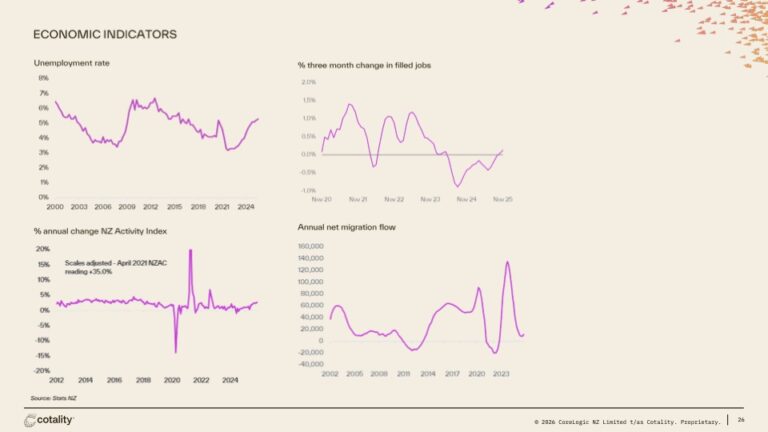
The latest economic indicators present a picture of an economy that is no longer in freefall, but not yet firing on all cylinders. Key measures such as employment, migration, and overall activity point to gradual stabilisation rather than a sharp rebound.
This matters for the housing market, because employment confidence, population growth, and economic momentum ultimately shape buyer demand.
Unemployment: Elevated but Appearing to Stabilise
The unemployment rate has risen from its historic lows and now sits noticeably higher than pre-pandemic levels. While this has weighed on confidence, recent movements suggest the pace of deterioration has slowed.
A stabilising labour market reduces the risk of forced selling and provides a more secure backdrop for household decision-making.
Employment Growth: Still Soft
The three-month change in filled jobs remains weak, with employment growth fluctuating around zero. This indicates that businesses remain cautious about hiring, reflecting lingering uncertainty across parts of the economy.
Until job growth strengthens more convincingly, household confidence is likely to improve only gradually.
Economic Activity: Off the Lows, but Subdued
The NZ Activity Index shows that overall economic activity has recovered from the extreme volatility of 2020–2021, but growth remains modest.
Rather than a strong expansion, the data points to an economy moving sideways, with pockets of improvement offset by areas of ongoing weakness.
Migration: A Key Support for Demand
Annual net migration remains one of the strongest supports for the housing market. While flows have been volatile, population growth continues to add pressure to housing demand — particularly in larger centres and key regional hubs.
This ongoing population growth helps explain why property values and rents have been more resilient than many expected during the downturn.
What This Means for Housing
Taken together, the indicators suggest:
This environment is consistent with a housing market that stabilises first, then recovers slowly.
The big takeaway
New Zealand’s economy is in a rebuilding phase. Employment growth is soft, unemployment is elevated, but migration and activity indicators suggest the foundations for recovery are forming.
For the housing market, this points to steady conditions rather than sharp swings — with any improvement in prices and sales likely to be gradual and closely tied to labour market confidence.
Source: Cotality – NZ Monthly Housing Chart Pack, February 2026