
Amber Bannister
Real Estate ● 22 Jan 2026
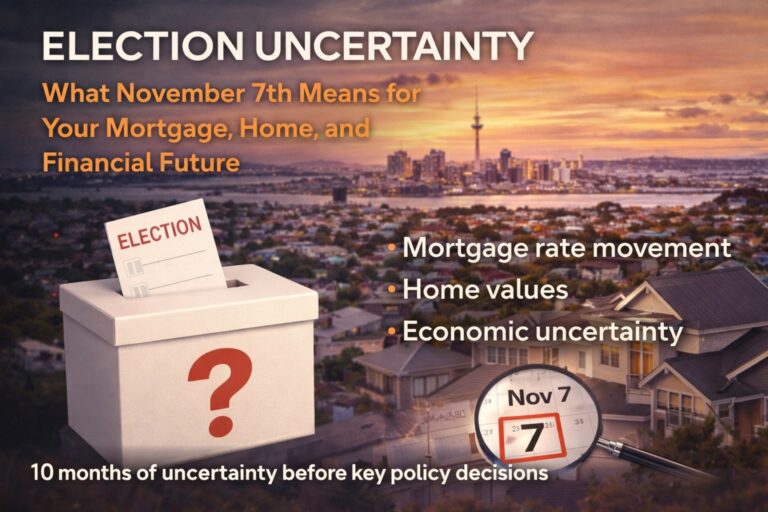
Yesterday’s announcement that New Zealand will head to the polls on November 7, 2026 has set the clock ticking on what promises to be one of the most consequential elections for the property market in recent memory. But what does this actually mean for your mortgage rate, your home’s value, and the broader economy?
The Election Timeline: Why This Matters Now
Prime Minister Christopher Luxon’s decision to announce the election date 10 months in advance follows a political tradition of giving certainty early. But in doing so, he’s also triggered something less predictable: election uncertainty (RNZ, January 21, 2026).
Markets don’t love uncertainty. Investors pause. Developers wait. And crucially for homeowners and buyers, decision-making gets delayed.
The question isn’t whether the election will impact the housing market and economy. History tells us it will. The real question is: how much, and what should you do about it?
What History Tells Us About Elections and House Prices
Looking at New Zealand’s last six elections, research from Colliers shows a clear pattern: 5 out of 6 elections had minimal impact on overall residential, commercial, and industrial sales activity month-to-month. The exception? The 2014 election, which saw noticeable shifts in buying activity (ASAP Finance, 2020).
But here’s where 2026 is different.
This isn’t a typical election year. We’re entering it with:
Property values that have declined 1% nationally over 2025 (Cotality, January 2026)
Mortgage rates near a cycle low at around 4.49% for 1-year fixed terms (Opes Partners, January 18, 2026)
An OCR that has hit 2.25% after nine consecutive cuts (RBNZ, November 2025)
Record net migration to Australia of 73,000 Kiwis in the past year (Labour Party Conference, 2025)
Stark policy differences between major parties on taxation and housing investment
In short: the home loan environment has settled, but policy uncertainty could change everything.
The Mortgage Rate Reality Check
Here’s the good news: your mortgage rate likely won’t change much before November.
Major banks including ANZ, ASB, BNZ, Kiwibank, and Westpac all expect the OCR to remain at 2.25% throughout 2026 before any potential upward movement begins in early 2027 (Canstar, December 2025).
Current rates as of January 18, 2026:
1-year fixed: 4.49% (all major banks)
2-year fixed: 4.69% (ANZ, BNZ, Kiwibank, TSB)
3-year fixed: 5.05% (Westpac – lowest)
Floating: 5.64% average
The catch? Banks are already pricing in expectation of future OCR increases through swap rate movements. While the RBNZ has effectively said “we’re done cutting,” wholesale borrowing costs for banks have risen, which means longer-term fixed rates may creep up before the election, particularly if economic data improves (ASB economists, January 2026).
What This Means for Borrowers
If you’re refinancing or buying between now and November, consider:
Short-term fixes (1-2 years) are historically cheap. Lock in certainty while you assess election outcomes.
Don’t assume rates will fall further. We’re likely at or near the bottom of the cycle.
Election outcomes could drive rate divergence in 2027. Different economic policies = different inflation outcomes = different OCR paths.
The Housing Market: Frozen in Anticipation?
Here’s where election timing gets interesting.
Cotality’s research analyst noted that “in an election year, which always tends to induce a bit of housing uncertainty, it’s not out of the question that Wellington’s property values continue to tread water to an extent in 2026” (Cotality, January 2026).
Auckland and Wellington—our two most expensive centres—have shown particular caution already, even before the election date was announced. With values down -1.3% to -3.5% across Auckland sub-markets in 2025, and Wellington showing similar softness, these markets were already demonstrating buyer ascendancy.
The November 7th date amplifies this dynamic in three ways:
1. The “Wait and See” Window Extends for 10 Months
Historically, electoral uncertainty creates a 6-month window of cautious behaviour around elections. Luxon’s November date—the latest typical election timing—means:
January-March: Business as usual (we’re here now)
April-September: Growing policy debate and uncertainty
October: Campaign intensity peaks, Parliament dissolves October 1
November 7: Election day
November-December: Coalition formation, policy clarity emerges
That’s 9 months of increasing uncertainty before voters decide. Property analyst commentators suggest this extended timeline could “restrain housing market activity, particularly among investors” (Newsroom, November 25, 2025).
2. The Capital Gains Tax Factor
Labour leader Chris Hipkins has committed to introducing a 28% capital gains tax on investment and commercial property (excluding family homes and farms) if Labour wins power (Labour Party Conference, 2025; Wikipedia, January 2026).
Research shows that previous periods when CGT was floated—in 2014 and 2018/2019—coincided with suppressed market activity. As Newsroom noted, “there is the risk that CGT chatter has a more immediate impact in restraining housing market activity, particularly among investors” (November 25, 2025).
For investors: The possibility of a July 2027 CGT implementation creates a strategic timing question. Do you:
Sell before the election to avoid potential CGT?
Hold, gambling on a National victory?
Buy, betting that Labour’s “homes first, investments second” rhetoric will cool competition from other investors?
For first home buyers: Reduced investor activity could mean less competition at the lower end of the market—potentially a rare window of opportunity.
3. Supply Remains Elevated—Buyers Have Power
Unlike previous recovery phases, dwelling consents remain well above long-term averages across Auckland, Waikato, and Canterbury (Stats NZ, reported by Luminate Finance, January 2026).
Combined with election-induced caution, this means 2026 remains a buyer’s market—at least until election results clarify policy direction.
The Economic Stakes: Two Different Visions
The election isn’t just about housing—it’s about fundamentally different economic approaches.
National’s Platform: Steady Recovery, Business Confidence
Luxon’s pitch centres on:
Economic recovery is “up and running” after inherited challenges
Inflation down from 7% to 3%
Tax cuts delivered, OCR cuts achieved
Promise of stability and “no deviation” from current plan if re-elected
Opposition to capital gains tax
Resource Management Act reform continuing
National is banking on the economy showing clear improvement by November, with ACT leader David Seymour noting the extended timeline “would make it likely any economic recovery more clear to voters ahead of election day” (NZ Herald, January 21, 2026).
Labour’s Platform: Redirect Investment to Productive Economy
Hipkins’ counter-argument:
“We can’t get rich as a country just by buying and selling houses from one another”
28% CGT on investment/commercial property to redirect capital to “productive” sectors
Revenue from CGT to fund health initiatives (3 free GP visits, cervical screening, economic investment fund)
Criticism that National’s “management speak” hasn’t delivered on housing affordability or healthcare access
“Nine out of 10 New Zealanders won’t pay a cent” under proposed CGT (Labour Party Conference, 2025)
The Economic Reality: It’s Complicated
Both parties face the same fundamental challenge: New Zealand’s economic recovery is fragile.
The facts:
GDP contracted a further 0.5% in the most recently measured 12 months (Yahoo News, January 21, 2026)
Migration to Australia remains at record highs
Business confidence is improving but remains tentative
The property market accounts for a significant portion of wealth storage
Productivity growth remains New Zealand’s Achilles heel
A Capital Gains Tax Could:
✅ Redirect some investment from property to productive sectors
✅ Reduce speculative demand, improving affordability for owner-occupiers
✅ Generate revenue for public services
❌ Cause property investors to exit market suddenly (potential price volatility)
❌ Create complexity in tax system
❌ Risk capital flight if implemented poorly
Maintaining Status Quo Could:
✅ Preserve certainty and confidence in near term
✅ Avoid market disruption from policy change
✅ Let current stabilization continue organically
❌ Perpetuate over-investment in property relative to productive assets
❌ Maintain affordability challenges for young families
❌ Continue productivity drag from misallocated capital
Regional Variations: Not All Markets Are Equal
The election’s impact won’t be uniform:
Auckland: Already showing caution and elevated supply. Likely to see extended sideways movement through election period, with particular softness in townhouse market where development pipeline remains robust.
Wellington: Similar dynamics to Auckland. Government employment uncertainty could compound electoral uncertainty. Expect continued “treading water” behaviour.
Canterbury/Christchurch: Has shown annual growth despite national decline. May prove more resilient through election period due to fundamentally stronger supply/demand balance.
Southland, Bay of Plenty: Regional strength likely to continue relatively undisturbed. These markets are less sensitive to national policy debates and more driven by local economic conditions.
Northland/Auckland expansion areas: Potential beneficiaries if Auckland buyers seek affordability while awaiting election clarity. Migration patterns within NZ could favor these regions.
What Should You Actually Do?
For First Home Buyers:
✅ Take advantage of the pause. Election uncertainty = less competition from investors = more negotiating power for you
✅ Lock in rates now. 1-year fixes around 4.49% are historically excellent
✅ Don’t wait for perfect timing. Life circumstances matter more than market timing
✅ Focus on locations with strong fundamentals regardless of election outcome
For Current Homeowners:
✅ Consider refinancing if your fixed term expires before November. Secure current low rates
✅ Don’t panic about election outcomes. Your home’s value is about location, condition, and long-term trends
✅ If upgrading, this buyer’s market works in your favor despite having to sell too
For Property Investors:
⚠️ Assess your CGT exposure. If Labour wins, properties held under two years already face bright-line test; CGT would apply to longer-term holdings
⚠️ Consider portfolio strategy now. Waiting until September/October could mean selling into a more cautious market
⚠️ Look at fundamentals, not politics alone. Some investments make sense regardless of tax policy
⚠️ Opportunity may exist in post-election dip if Labour wins and others panic-sell
⚠️ Labour’s CGT explicitly includes commercial property. Strategic timing consideration for any planned divestments
✅ Extended election period = extended opportunity to position for post-election market
⚠️ Monitor business confidence. Commercial property value ultimately reflects economic activity
The Bigger Picture: Navigating Uncertainty with Strategy
Here’s what we know for certain:
Mortgage rates have likely bottomed. The upside risk is small in 2026, but the era of cuts is over.
Housing market will be cautious through November. Historical patterns and current policy debates guarantee this.
Regional divergence will continue. National trends matter less than local supply/demand.
Policy uncertainty is temporary. By December, we’ll have clarity—one way or another.
Life doesn’t wait for elections. If you need a home, or need to refinance, or have a legitimate investment thesis, don’t let politics alone drive your decision.
The property market doesn’t care about our political preferences. It responds to interest rates, supply, demand, and sentiment. Right now, we have low rates, elevated supply, improving demand, and uncertain sentiment.
That’s actually a functional market—not a crisis.
The election will add short-term noise. But the underlying trajectory—gradual recovery, regional variation, modest price growth in the 3-5% range—is likely to reassert itself once voters have their say.
Your job between now and November isn’t to predict electoral outcomes. It’s to make sound financial decisions based on your circumstances, informed by evidence, and aligned with your long-term goals.
And that’s exactly what we’re here to help you do.
Sources
RNZ (January 21, 2026). “Christopher Luxon announces election date for 7 November.” https://www.rnz.co.nz/news/political/584623/
NZ Herald (January 21, 2026). “Watch: Luxon confirms 2026 election date, rules out three parties from coalition consideration.” https://www.nzherald.co.nz/nz/politics/
Opes Partners (January 18, 2026). “Current mortgage interest rates in NZ [2026].” https://www.opespartners.co.nz/mortgage/interest-rates
Canstar (December 15, 2025). “Where Will Mortgage Rates Go in 2026?” https://www.canstar.co.nz/home-loans/when-will-interest-rates-go-down/
Reserve Bank of New Zealand (Multiple dates, 2025-2026). “New residential mortgage standard interest rates (B20).” https://www.rbnz.govt.nz/statistics/series/exchange-and-interest-rates/
MoneyHub NZ (January 2026). “Interest Rate Predictions 2026 & 2027.” https://www.moneyhub.co.nz/interest-rate-predictions.html
Cotality (January 2026). “NZ Home Value Index: How Property Values Finished 2025 Across the Main Centres.” https://www.integraladvice.co.nz/nz-home-value-index-how-property-values-finished-2025-across-the-main-centres/
Newsroom (November 25, 2025). “New Zealand house prices: flat trend to bend upwards in 2026, supply to limit gains.” https://newsroom.co.nz/2025/11/26/new-zealand-house-prices-flat-trend-to-bend-upwards-in-2026-supply-to-limit-gains/
Luminate Finance (January 2026). “The 2026 housing market: steady, political, and quietly shifting.” https://insights.luminate.co.nz/the-2026-housing-market-steady-political-and-quietly-shifting
Squirrel (December 16, 2025). “NZ property market update — Outlook for 2026.” https://www.squirrel.co.nz/blog/housing-market/nz-property-market-update-outlook-for-2026
RNZ (December 2, 2024). “Labour lays groundwork for election-year capital gains tax.” https://www.rnz.co.nz/news/political/535446/
Labour Party of New Zealand (2025). “Speech to Labour Party Conference 2025: Chris Hipkins.” https://www.labour.org.nz/news/speech-to-labour-party-conference-2025-chris-hipkins/
Wikipedia (January 22, 2026). “Chris Hipkins.” https://en.wikipedia.org/wiki/Chris_Hipkins
Yahoo News/AP (January 21, 2026). “New Zealand election scheduled for Nov. 7 with the costs of living and housing the top issues.” https://www.yahoo.com/news/articles/zealand-election-scheduled-nov-7-005414474.html
ASAP Finance (December 7, 2021). “Market Update and Impact of General Election on the NZ Property Market.” https://asapfinance.co.nz/blog/market-update-and-impact-of-nz-elections/
Lighthouse Financial (September 23, 2023). “Election Special: What Happens To House Prices Under A National Or Labour Government.” https://lighthousefinancial.co.nz/podcasts/election-special-what-happens-to-house-prices-under-a-national-or-labour-government/
Disclaimer: This article is for informational purposes only and does not constitute financial advice. Readers should seek professional advice tailored to their individual circumstances before making financial decisions. All information is accurate as of January 22, 2026, and subject to change.