
Amber Bannister
Real Estate ● 2 Jan 2026
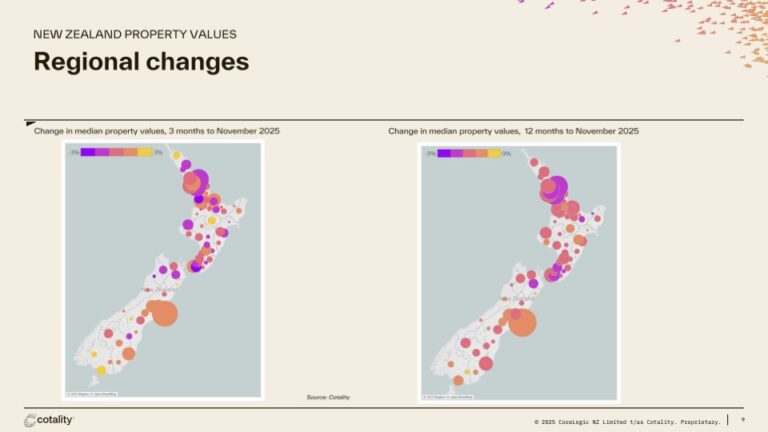
The New Zealand property market may be stabilising overall, but when you look beneath the national averages, a very different story emerges. Recent data shows that property values are moving at different speeds across the country, with some regions gaining momentum while others continue to lag.
The latest regional breakdown makes it clear that location — and affordability — now matter more than ever.
Short-Term Movements: Three-Month Changes
Over the three months to November 2025, property values showed a mixed pattern across the country. Some regions recorded modest gains, while others remained flat or slipped slightly.
These short-term changes suggest that confidence is slowly returning in pockets of the market, particularly in regions where affordability remains strong and buyer demand is steady.
In contrast, higher-priced areas have seen more subdued short-term performance, reflecting continued caution among buyers.
Longer-Term Picture: Twelve-Month Changes
Looking at the past 12 months, regional differences become even clearer. Some parts of the country are now showing annual growth, while others are still adjusting after the sharp correction of recent years.
Regions that experienced more moderate price growth during the boom have generally held up better, whereas areas that saw rapid price escalation between 2020 and 2022 are taking longer to recover.
Affordability Is Driving Regional Performance
The strongest-performing regions tend to share common characteristics:
Meanwhile, regions with higher price points and heavier reliance on borrowing capacity remain more sensitive to interest rates and lending conditions.
A Shift Away From a One-Speed Market
The maps highlight a key change in New Zealand’s housing cycle. Instead of a nationwide boom or bust, the market is now moving in a more fragmented way.
This shift means buyers and sellers need to focus far more on local data, rather than relying on national trends.
The big takeaway
New Zealand’s property market is no longer moving as a single unit. Regional differences are widening, with affordability and local conditions determining which areas recover first.
For buyers, this creates targeted opportunities. For sellers, it reinforces the importance of pricing to local market realities. And for the market overall, it signals a transition toward a more balanced, region-led recovery.
Source: Cotality – NZ Monthly Housing Chart Pack, December 2025