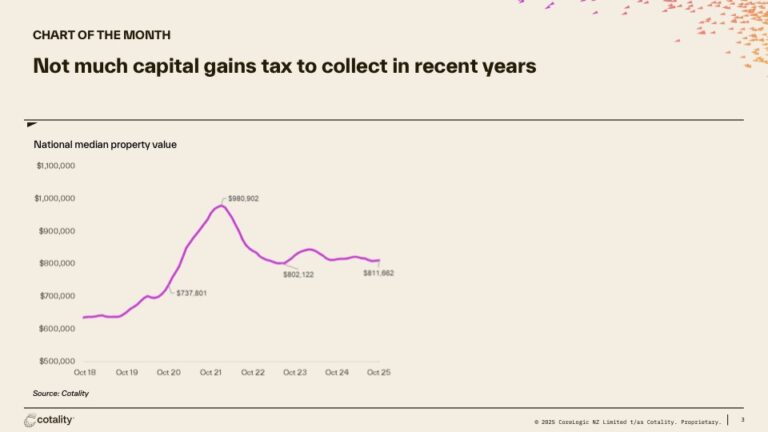
For years, the idea of a Capital Gains Tax (CGT) has floated around New Zealand politics, usually sparking big debates about fairness, affordability, and whether housing should be taxed like other investments. But according to recent housing data, even if New Zealand had a broad capital gains tax in place, the Government wouldn’t have collected much — simply because there haven’t been many gains to tax in the first place.
The latest housing figures show that property values are still well below their 2022 peak, and the modest changes since then mean there’s been very little capital growth for owners to actually pay tax on.
Values Are Still Down From the Peak
National median value data shows:
- Property values remain around 17% below the early-2022 peak.
- Values are only about 1% higher than the market low recorded in mid-2023.
- They’re only about 10% higher than five years ago, a period that historically delivered far stronger growth.
This means many people who bought within the past five years have seen very little capital gain — and some are sitting on paper losses.
Why the Gains Just Aren’t There
A CGT only generates revenue when values keep rising. Over the past few years, the market has been held back by:
- High interest rates
- A natural cooling after the pandemic-era boom
- Soft wage growth
- Political uncertainty around tax and investor settings
- Affordability constraints limiting price escalation
Together, these pressures have flattened New Zealand’s property value curve, keeping prices well below their previous highs.
Investors Are Wary — And This Data Shows Why
Some property investors remain cautious about political risk, especially following renewed conversations about capital gains taxes. But even if such a tax were implemented, the reality is simple: with so little upward movement in values, there wouldn’t be much for the Government to tax.
For a CGT to generate meaningful revenue, the market must deliver consistent, strong capital growth — something New Zealand hasn’t seen since 2021.
Where the Market Is Heading Next
While the past few years have delivered little in the way of capital gains, the outlook for 2026 is more optimistic. Several factors point toward a steadier recovery:
- Easing mortgage rates
- Fewer listings compared to last year
- Improving affordability in many regions
- More households refinancing onto lower rates
- Forecast declines in unemployment
Together, these factors suggest the market could begin rising again — slowly and steadily rather than at the pace seen during the 2020–2021 surge.
The big takeaway
New Zealand hasn’t seen much capital growth in property for several years — meaning any hypothetical capital gains tax would have generated modest revenue at best. Values remain well below their peak, and gains have been muted and inconsistent.
For homeowners and investors, the past few years have been more about holding steady than cashing in. For policymakers, the data reinforces that tax debate only becomes meaningful when the market is actually delivering strong gains.
For buyers, this prolonged flat period may represent the breathing room and opportunity they’ve been waiting for.
Source: Cotality – NZ Monthly Housing Chart Pack, November 2025